

Rethinking Prosthetics

The Problem
A prosthetic socket is custom-fitted to a body that is constantly changing. Residual limbs naturally swell and shrink, but traditional sockets offer very little adjustability. A prosthesis that fits in the morning can become uncomfortable later in the day. The process of creating a traditional socket is also time-consuming, often requiring multiple clinical visits and adjustments without guaranteeing a satisfactory fit. For some amputees, the discomfort and frustration eventually lead to abandoning the prosthesis altogether.
At LIM Innovations, we wanted to rethink that experience—not simply create another prosthetic socket, but develop a system that could adapt to the person using it.

Building and learning
The design challenge was to balance structural support, comfort, adjustability, and manufacturability without making the product unnecessarily complicated for clinicians or amputees. We approached development through rapid cycles of prototyping, testing, and refinement. Working closely with our multidisciplinary team allowed us to evaluate ideas quickly, identify problems, and incorporate what we learned into the next iteration.
My work covered research, mixed-material industrial design, and translating user insights into physical design decisions. I also contributed to the development of new product and manufacturing processes as we moved toward commercialization.
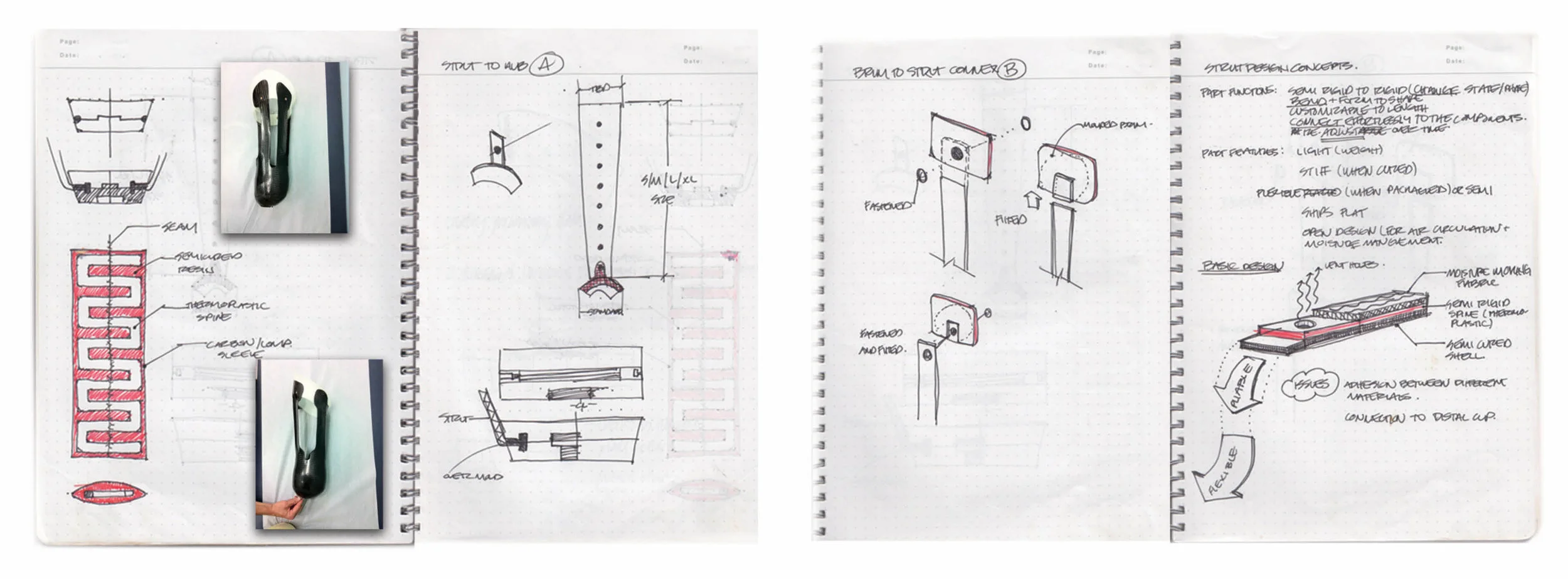
Early sketches
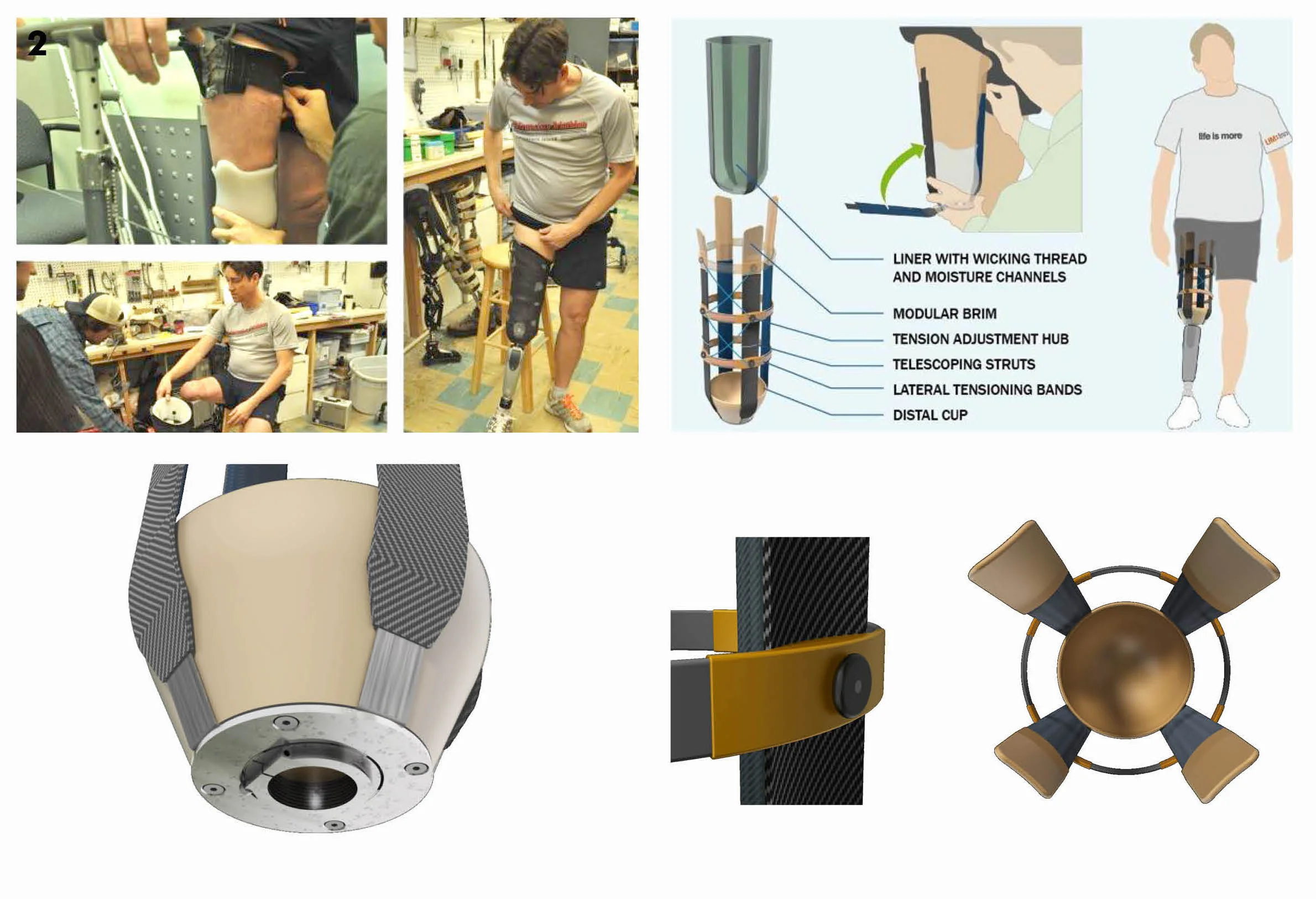

Rough prototype validated by our users.
Curiosity, materials first mentality, and making things work.
When I joined LIM, I had industrial design experience but a great deal to learn about prosthetics. I immersed myself in the anatomy of the residual limb, existing socket designs, manufacturing processes, and emerging materials. Working alongside surgeons, prosthetists, and materials engineers, I led user research with amputees and helped establish our product development process. We studied the entire experience of living with a prosthesis, from the initial clinical visits to the everyday challenges of wearing and adjusting it.
One important realization was that fitting a prosthesis wasn't the end of the problem. The product needed to accommodate changes in the body long after the initial fitting.I helped develop a product vision and roadmap combining 3D scanning, customized structures, advanced carbon-fiber materials, and adjustable-tension technology.

the outcome
Within 18 months, our first customers were wearing our prosthetics. I contributed to the development of two adjustable prosthetic socket products that gave users greater control over their fit as their bodies changed.
The new approach reduced the need for repeated prosthetist visits and addressed one of the fundamental reasons prostheses go unused. Several of the resulting innovations were patented.
What I value most about this project is that our work wasn't driven by a predetermined product idea. It developed through a combination of listening to users, understanding the underlying technical problem, and working together to build and test alternatives.

The Ultimate Wearable
The most comfortable and adjustable custom socket for above-knee amputees. Every aspect of the Infinite Socket™ TF was designed and engineered with comfort and lifestyle in mind. Inspired by the design and manufacturing of bicycle saddles, the socket mimics human anatomy to provide improved function, adjustability, and comfort. The Infinite Socket™ TF adjustable components enable both patients and clinicians to fine-tune fit for better comfort and control. A modular frame and carbon fiber struts make it easy for prosthetists to make modifications in response to body fluctuations.